Every child is born a natural scientist, endlessly curious, constantly experimenting, building theories about the world, and testing them with relentless enthusiasm. Somewhere along the way, most schools teach that out of them. Constructivism is about giving it back.
Watch a toddler discover a puddle for the first time.
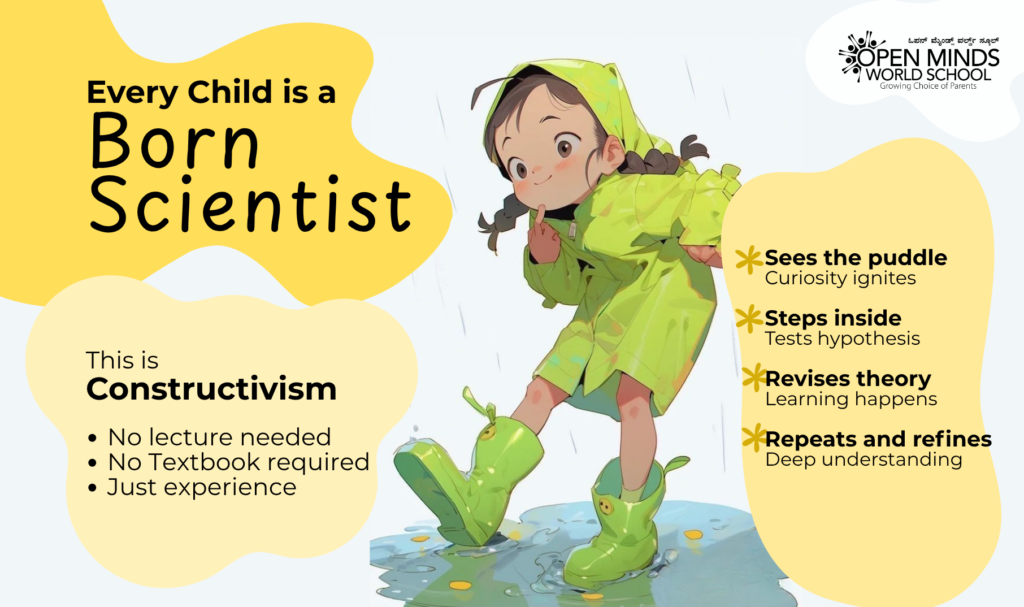
She does not wait for someone to explain what water is. She does not sit still while a mentor talks about surface tension. She walks into it. Splashes in it. Falls over. Gets up. Splashes again. Picks up a stick and pokes it. Watches the ripples. Laughs. Tries again.
In those five minutes, she has formed more genuine scientific understanding about fluid dynamics, cause and effect, and the physical properties of liquids than she would from an hour of classroom instruction on the same topic.
This is constructivism in its purest form. And it is how all children, not just toddlers, naturally learn. The question that Open Minds World School, the most progressive school in Shimoga, asks is simple: if this is how children naturally learn, why do so few schools teach this way?
Table of Contents
What Is Constructivism?
Constructivism is not a teaching technique. It is not a classroom strategy or a lesson format. It is a theory of how human beings actually build knowledge, and it has profound implications for how education should work. The core idea is this: children do not receive knowledge from the outside and passively store it. They construct knowledge from the inside by actively engaging with the world, making connections, forming hypotheses, testing them, and revising their understanding based on what they discover.
Piaget & Vygotsky – The Two Fathers of Constructivism
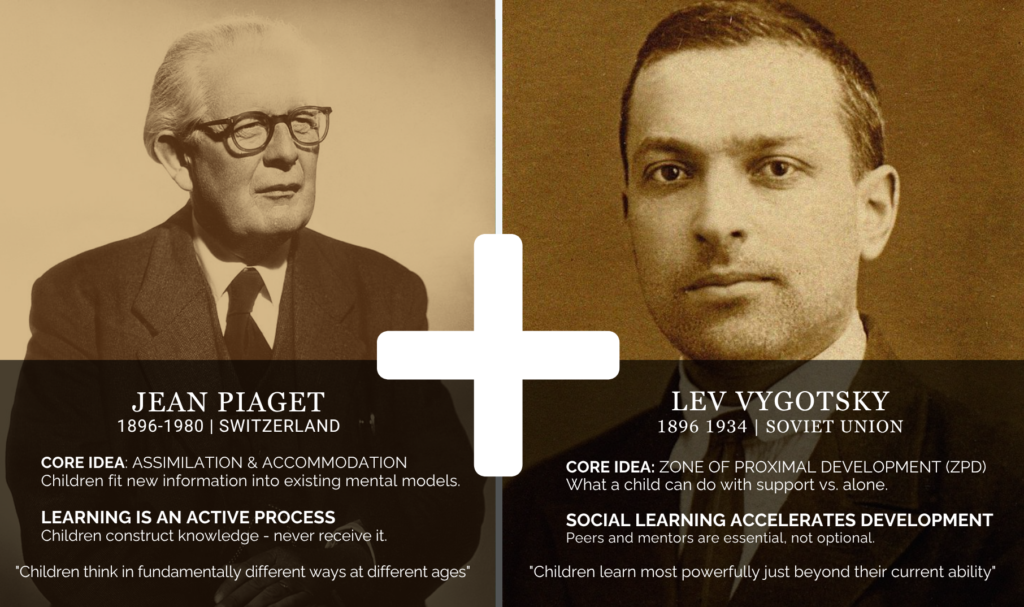
Two thinkers are central to constructivist theory:
| Jean Piaget (1896–1980) Swiss developmental psychologist Jean Piaget spent decades observing how children think and discovered that children are not small adults who simply know less. They think fundamentally differently at different stages of development. Piaget argued that children build understanding through two processes: assimilation (fitting new experiences into existing mental frameworks) and accommodation (revising those frameworks when new experiences don’t fit). Learning, for Piaget, is always an active, constructive process. |
| Lev Vygotsky (1896–1934) Soviet psychologist Lev Vygotsky added a crucial social dimension to constructivist theory. He argued that children learn most powerfully in the ‘zone of proximal development,’ the space between what they can do alone and what they can do with the support of a more knowledgeable peer or mentor. This is why mixed-age learning and peer mentorship are not merely nice ideas; they are scientifically validated accelerators of deep learning. |
Together, Piaget and Vygotsky gave us a picture of learning that is radically different from what most conventional schools, including the average CBSE school in Shimoga, actually practice.
What Conventional Schools Actually Do (And Why It Doesn’t Work)
Two Classrooms – One Question: Which one is yours?
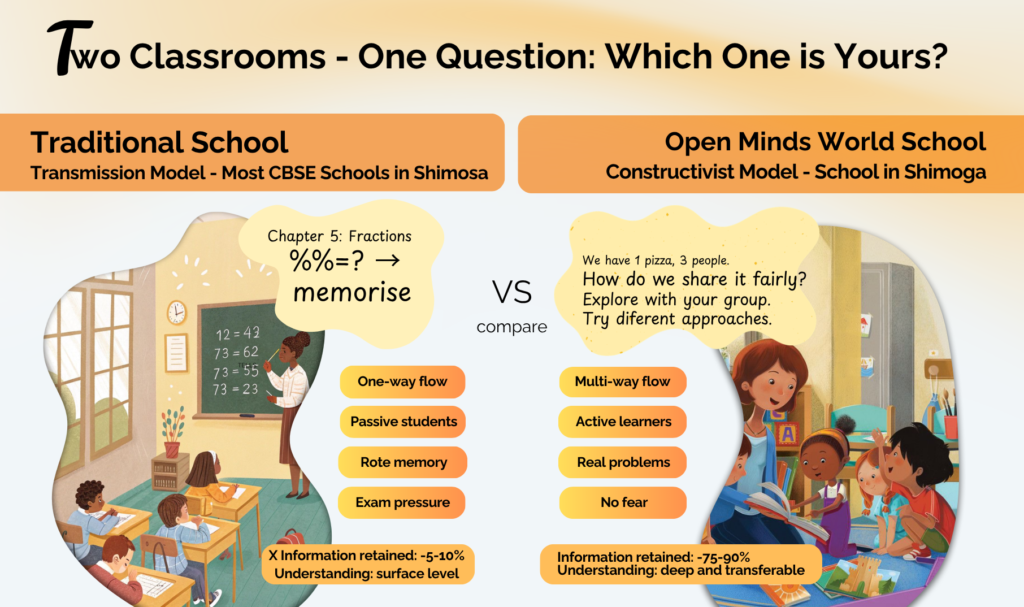
The dominant model of schooling in India and across most of the world is what educational theorists call the transmission model of education. The name is revealing. Knowledge, in this model, is treated like a substance that can be transmitted from mentor to student, as water poured from one jug into another.
The mentor has the knowledge. The student does not. The mentor speaks. The student listens. The mentor sets a test. The student reproduces what was said. The student is marked on the accuracy of reproduction. This is called learning.
Constructivism says this is wrong not morally, but scientifically.
“You cannot teach a child anything. You can only create the conditions under which they will learn for themselves.” Jean Piaget
Here is why the transmission model fails, and why it produces the outcomes that parents in Shimoga and across Karnataka are increasingly rejecting:
Problem 1: The Brain Does Not Work Like a Hard Drive
The transmission model assumes that information can be inserted into a child’s brain and will remain there, ready to be retrieved on demand. Decades of neuroscience research have demolished this assumption.
Information that is not connected to prior knowledge, not processed through active engagement, and not applied to real situations does not stick. It enters short-term memory and evaporates, typically within days, sometimes within hours of the exam for which it was memorised.
This is why a child who scores 85% in a science exam in March cannot explain the concept being tested in April. The marks were real. The learning was not.
Problem 2: Passive Listening Is the Least Effective Way to Learn
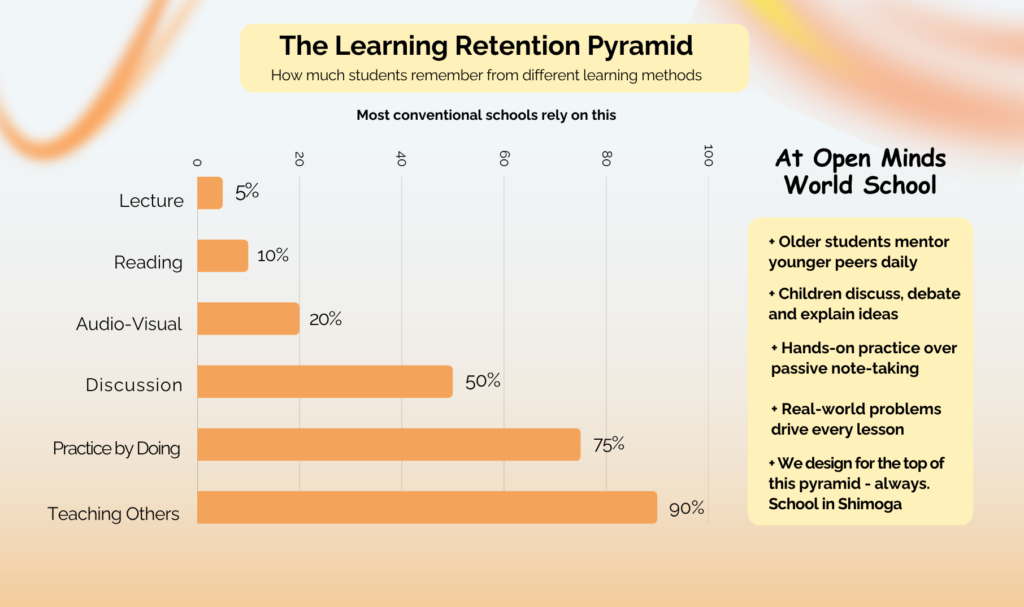
Research on learning retention, including the widely referenced work of educational psychologist Edgar Dale, consistently shows that passive listening is among the least effective modes of learning. Students typically retain:
• Around 5% of what they hear in a lecture
• Around 10% of what they read
• Around 20% of what they see demonstrated
• Around 50% of what they discuss with others
• Around 75% of what they practice by doing
• Around 90% of what they teach to someone else
Notice what tops this list: teaching others. This single finding is the scientific basis for the learning-by-teaching method that Open Minds World School uses, where older students in our mixed-age groups actively mentor younger peers, deepening their own mastery in the process.
Problem 3: The Wrong Kind of Questions
In most conventional classrooms, the questions flow in one direction: from mentor to student. “What is the capital of France? What is the formula for water? When did Aurangzeb die?”
These are closed questions with single correct answers. They test recall, not understanding. They reward memory, not thinking.
Constructivist classrooms reverse this. Students ask questions. The mentor’s role is not to provide answers but to provide better questions to probe, to challenge, to open up new lines of inquiry. The question that drives a constructivist lesson is not “what is the answer?” but “what do you think, and how did you arrive at that thinking?”
Problem 4: Age-Based Grouping Kills Vygotsky’s Zone
Vygotsky’s zone of proximal development tells us that children learn most powerfully when they are just beyond their current ability level, supported by someone slightly more advanced. In a constructivist model, this support comes from peers and mentors together.
But the conventional CBSE school in Shimoga model places every child with peers of the same age, at the same stage, competing for the same marks. There is no natural mentor. No one has just mastered what you are currently struggling with and can explain it in the language of a fellow learner.
This is why mixed-age learning, one of the defining features of Open Minds World School, is not simply a structural choice. It is a direct application of the best science we have about how children grow.
What Constructivism Looks Like in Practice?
Abstract theory is only useful if it translates into a real classroom experience. So what does a genuinely constructivist school in Shimoga actually look like, day to day?
At Open Minds World School, constructivism is not a philosophy we hang on the wall. It shapes every element of how learning happens:
Learning Begins With a Problem, Not a Lesson
In a traditional school, a lesson might begin: “Today we are going to learn about fractions.” A mentor explains fractions, writes examples on the board, and children copy them down.
In a constructivist classroom, the same concept might begin differently. Children are given a situation: “We have one pizza and three people. How do we share it fairly?” The problem is real. The need to understand fractions emerges naturally from the attempt to solve it. By the time the word “fraction” is introduced, children already have a felt, embodied sense of what it means.
This is our concept-based curriculum in action. Every subject at Open Minds World School begins with a real-world problem statement a question that makes the concept necessary, not arbitrary.
The mentor as Guide, Not Gatekeeper
In a constructivist classroom, the mentor’s role changes fundamentally. She is not the source of all knowledge. She is the most knowledgeable person in the room, but her expertise is deployed not in delivering information, but in designing the conditions for learning.
She asks questions that open up thinking rather than closing it down. She offers resource books, internet access, materials, experiences, and lets children explore. She observes where each child is struggling and offers targeted support. She knows when to intervene and when to let the productive struggle continue.
This is a far more skilled and demanding role than the transmission model requires. It is also far more effective, and it is the model that defines every mentor at Open Minds World School, the leading school in Shimoga for progressive education.
Peer Discussion Is Not a Break From Learning, It Is Learning
In most schools, talking in class is discouraged. Silence signals attention. Noise signals chaos.
In a constructivist classroom, rich discussion is the primary medium of learning. Children debate ideas. They challenge each other’s reasoning. They explain their thinking. They listen to alternative perspectives and revise their understanding. They build arguments and defend them.
This is not socialising. It is the highest form of cognitive engagement, and it produces understanding that no amount of silent note-taking can replicate.
Mistakes Are Data, Not Failures
Perhaps the most profound shift in a constructivist classroom is the relationship with error. In a conventional school, a wrong answer is a failure. In a constructivist classroom, a wrong answer is information.
It tells the mentor exactly where the child’s current mental model breaks down. It tells the child that their current framework needs revision. And the process of revising it, of figuring out where the thinking went wrong, and building a better model is the most powerful learning of all.
At Open Minds World School, our credit-based evaluation system is built on this understanding. We do not mark children down for being wrong. We assess the quality of their thinking, the depth of their understanding, and their ability to apply knowledge not their ability to reproduce it without error under exam conditions.
Why Most Schools, Including Most CBSE Schools in Shimoga, Get This Wrong?
If constructivism is so well supported by research, and it is, with over a century of evidence behind it, why don’t more schools practice it?
The honest answer is that genuine constructivist education is harder to implement, harder to measure, and harder to scale than the transmission model. And school systems, under pressure to show results quickly and quantifiably, consistently default to what is easiest to measure, not what is most effective.
It Requires Smaller Classes
A constructivist mentor working with 40 children cannot individualise effectively. She cannot track where each child’s understanding currently sits, cannot provide targeted support, and cannot facilitate meaningful peer discussion. The model breaks down at scale.
This is why Open Minds World School deliberately limits learning groups to 6–12 students. It is not a luxury. It is a prerequisite for genuine constructivist practice, and it is one of the things that most sharply distinguishes our school in Shimoga from every conventional CBSE school in Shimoga.
It Requires Knowledgeable mentors
A mentor who merely reads from a textbook can operate effectively in the transmission model. A constructivist mentor needs deep subject knowledge deep enough to ask good questions, follow unexpected lines of student inquiry, and recognise when a child’s novel approach to a problem is actually more sophisticated than the expected method.
This requires a different kind of mentor training, a different culture of professional development, and a school leadership that values intellectual depth over curriculum compliance. It is rare. At Open Minds World School, it is the standard we hold ourselves to.
It Resists Simple Measurement
The transmission model produces data that looks good in spreadsheets: percentages, ranks, pass rates. Constructivist learning produces outcomes that are harder to quantify but far more valuable: intellectual confidence, genuine understanding, curiosity, the ability to transfer knowledge to new contexts.
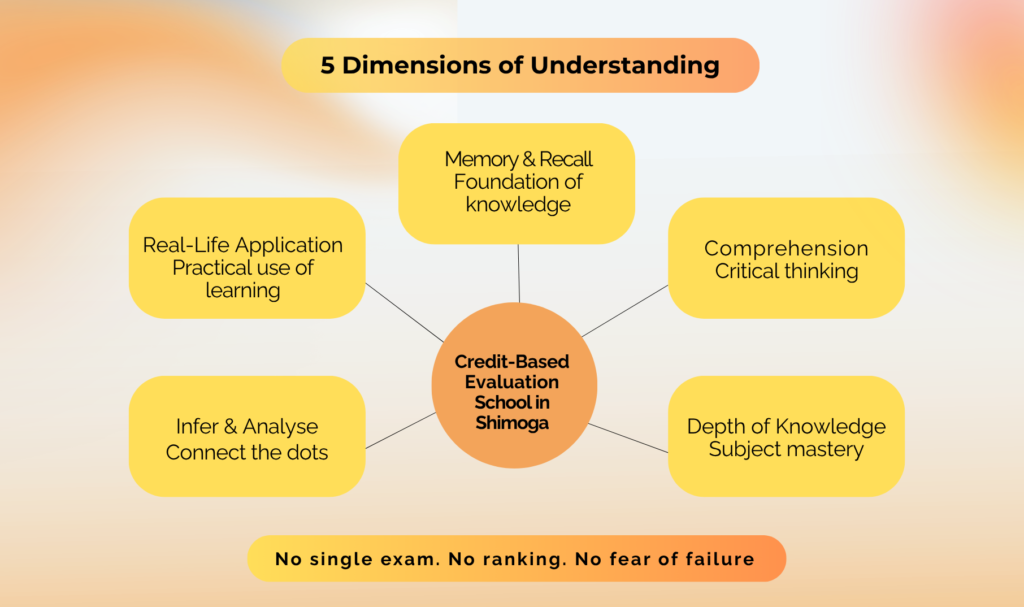
Our credit-based evaluation system is our answer to this challenge. It assesses children across five dimensions memory and recall, comprehension and critical thinking, depth of knowledge, ability to infer and analyse, and practical real-life application. It gives a richer, truer picture of a child’s learning than any single exam score could.
What does this mean for Your Child?
If you are a parent in Shimoga reading this and something is resonating, if you have watched your child memorise and forget, struggle and shut down, arrive at school curious and come home defeated, then what you are recognising is the gap between how your child naturally learns and how their school asks them to learn.
That gap is not your child’s fault. And it is not inevitable.
A constructivist education, the kind that Open Minds World School offers as the only truly progressive school in Shimoga, gives children:
1. Understanding that lasts, not marks that fade.
2. Confidence to tackle problems they have never seen before.
3. The habit of questioning, which is the beginning of all genuine intelligence.
4. A relationship with learning that is driven by curiosity, not fear.
5. Skills that transfer because they understand the principles, not just the procedures.
| The Constructivist Difference at Open Minds World School in Shimoga – Every lesson begins with a real-world problem, not a textbook chapter. – Children explore with books, the internet, materials, and peer discussion. – Tutors guide and question; they do not lecture and test. – Mixed-age groups (6–12 students) activate Vygotsky’s zone of learning. – Credit-based evaluation assesses understanding, not reproduction. – Mistakes are welcomed as information, not punished as failure. |
A Final Thought
The toddler at the puddle does not need to be taught to learn. She already knows how. What she needs is an environment that honours that natural impulse that gives it space, resources, and the guidance of someone who knows how to ask the next good question.
That is what constructivist education offers. That is what Open Minds World School has built in the heart of Shimoga for every child who walks through our doors.
If your child is between 3 and 18 years old, and you live in Shimoga or the surrounding districts, we would love to show you what learning looks like when it is built the way children actually learn.
Come and see a classroom where questions are more valued than answers and where every child leaves knowing more about who they are and what they are capable of.
Book a Visit · Open Minds World School The Constructivist School in Shimoga
Now enrolling:
Playschool, Nursery, Jr. KG, Sr. KG, Grade 1 & Grade 2 (Ages 3–8)
Open Minds World School · Shimoga, Karnataka
Karnataka’s most progressive alternative to conventional CBSE schooling.
Constructivist methodology · Mixed-age learning · Credit-based evaluationWaldorf-inspired · Concept-based curriculum · Small groups of 6–12 students
→ openmindsworldschool.com | Book a free school visit today