The real world is not organised by age. Workplaces, families, and communities bring people of different ages and abilities together constantly. Yet almost every school in India puts children of the same birth year into a room and calls it a class. Here is why that decision is stranger than it sounds — and what a better alternative looks like.
Think about the last time you learned something genuinely new and useful.
Perhaps it was a skill taught to you by a more experienced colleague at work. Perhaps it was something you figured out alongside a friend who was slightly further along than you in a shared project. Perhaps it was something you came to understand more deeply because you had to explain it to someone who knew less than you did.
Almost certainly, it was not learned by sitting in a room with twenty-five people of exactly your age, all receiving identical instruction from someone at the front of the room.
This observation matters because it points to a fundamental mismatch at the heart of conventional schooling. The environment in which children spend their most formative learning years — the age-graded classroom — bears almost no resemblance to the environments in which human beings actually learn and work throughout the rest of their lives.
Mixed-age learning is not a radical new experiment. It is a return to the way human communities have always educated their young — through the natural mixing of ages, the organic transfer of knowledge from those who know more to those who know less, and the social dynamics that arise when people at different stages of development share a common space and purpose.
At Open Minds World School, the leading school in Shimoga built on this principle, we organise our students into mixed-age groups of 6 to 12 children. This is not a compromise or a resource constraint. It is one of the most deliberate and evidence-supported decisions we have made — and this article explains why.
The Age-Graded Classroom: A Historical Accident
The age-graded classroom — in which every child of the same birth year is placed together and expected to move through identical content at the same pace — is so familiar that most people assume it must reflect something fundamental about how children learn. It does not.
The age-graded system was developed in Prussia in the early 19th century and spread globally during the period of industrial mass education. Its purpose was administrative efficiency: by grouping children of the same age, schools could move large numbers of children through a standardised curriculum using a small number of trained teachers. It was a production-line model, designed for the production-line era.
Before this system became dominant, children of different ages had always learned together — in homes, in community settings, in apprenticeships, and in the small rural schools that preceded mass education. The multi-age learning environment was not a special pedagogical choice. It was simply how education worked when communities were organised around genuine human relationships rather than institutional efficiency.
The age-graded classroom served the purposes for which it was designed. But those purposes were the purposes of 19th-century industrial society — producing literate, numerate workers who could follow instructions. The purposes of 21st-century education are different. And the evidence increasingly suggests that the age-graded classroom is a poor vehicle for achieving them.
Grouping children by the year they were born is one of the most consequential assumptions in education — and one of the least examined.
What the Real World Actually Looks Like
The phrase 'preparing children for the real world' is used constantly in education — usually to justify harder examinations, more pressure, or more rigid instruction. It is worth asking what the real world actually looks like, and whether the conventional classroom prepares children for it.
Workplaces Are Multi-Age
Every workplace brings together people of significantly different ages, experience levels, and abilities. A new graduate works alongside people with twenty years of experience. A senior manager collaborates with junior colleagues who know things they do not. A team solving a complex problem draws on the different expertise of its members, regardless of who is oldest or youngest.
Success in this environment requires precisely the skills that mixed-age classrooms develop: the ability to learn from those who know more, the ability to teach and support those who know less, the flexibility to move between these roles as the situation demands, and the social intelligence to navigate relationships with people at different stages of experience and knowledge.
The age-graded classroom, in which every child is always surrounded by peers of exactly the same age and developmental stage, provides essentially no preparation for this. In the conventional CBSE school in Shimoga classroom, a child never has the experience of being the most knowledgeable person in the room, or of genuinely depending on a peer who has recently mastered what they are currently struggling with.
Families Are Multi-Age
The family — the primary human community — is profoundly multi-age. Siblings at different stages of development, parents, grandparents, extended family: human beings grow up embedded in communities of different ages and learn, from the very beginning of their lives, to navigate those relationships.
The mixed-age classroom mirrors and extends this natural social structure. A younger child in a mixed-age group relates to older children in ways that draw on the same social instincts they use with older siblings. An older child takes responsibility for younger ones in ways that build on the same instincts that develop in family contexts. The social environment feels natural because it reflects a structure that human beings are deeply evolved to inhabit.
Learning Communities Are Multi-Age
Beyond work and family, the communities in which genuine intellectual development happens — research groups, creative communities, professional networks, communities of practice — are always multi-age. Ideas develop through the interaction of people at different stages of understanding. Expertise is transmitted through mentorship relationships that cross age boundaries.
A child who has spent twelve years in an age-graded classroom has spent twelve years in an environment that does not resemble any of these real-world learning communities. A child who has spent their school years in genuinely mixed-age groups has been practising, every day, the social and intellectual dynamics that characterise every meaningful learning and working community they will ever join.
What the Research Shows
The case for mixed-age learning is not simply a philosophical argument. It is supported by a substantial body of educational research accumulated across several decades and multiple countries.
Academic Outcomes
Multiple studies examining academic outcomes in mixed-age and single-age classrooms have found that mixed-age grouping produces equivalent or superior academic outcomes across most subjects and age groups studied.
The research is particularly clear in certain areas. In literacy development, younger children in mixed-age groups consistently demonstrate accelerated reading development compared to same-age peers in single-age classrooms. The mechanism appears to involve both the modelling effect — younger children watching older peers engage with text — and the increased oral language interaction that mixed-age environments naturally generate.
In mathematics, the evidence shows that the collaborative problem-solving that mixed-age groups naturally produce leads to deeper conceptual understanding than the individual practice that dominates single-age classrooms. Children who must explain their mathematical thinking to peers who do not yet understand it develop a much more secure grasp of the underlying concepts than children who only practice procedures.
The Tutor Effect
One of the most robust findings in all of educational research concerns what happens when one child teaches another. Studies consistently show that the child doing the teaching gains as much — and in some measures, more — than the child being taught.
The mechanism is well understood. Teaching requires a qualitatively different engagement with knowledge than learning. To teach something, you must organise what you know, identify what is essential, find the language to explain it clearly, monitor whether your explanation is working, and adjust when it is not. Each of these activities deepens understanding in ways that passive reception of instruction never can.
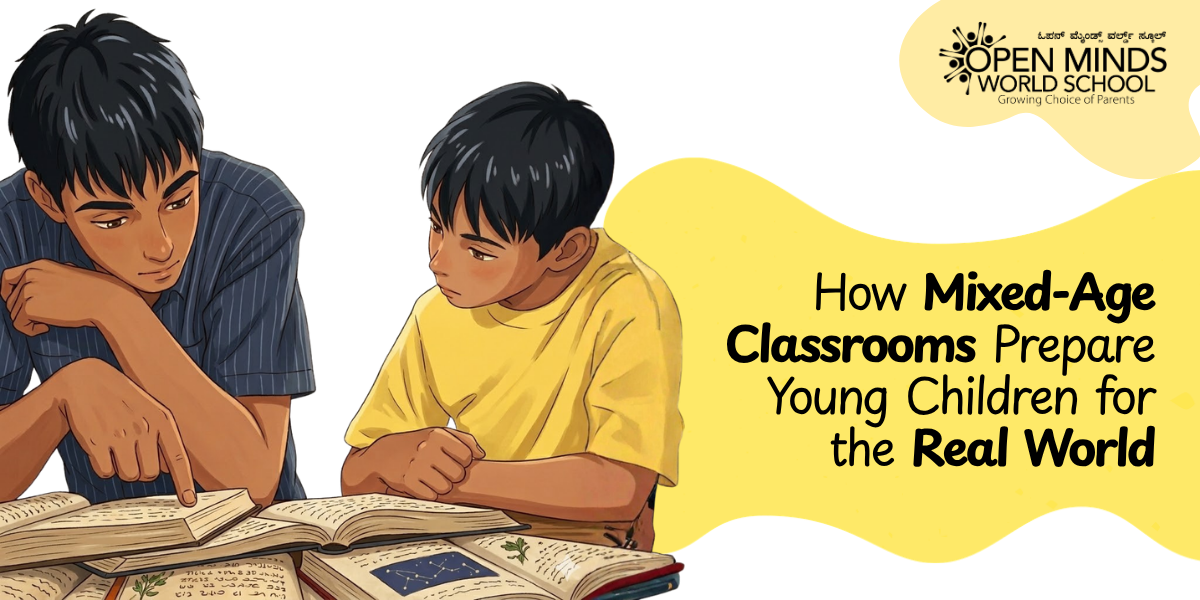
Mixed-age classrooms create the conditions for this kind of peer teaching to occur naturally and frequently. At Open Minds World School, older students regularly work with younger ones — not as a formal programme, but as the organic consequence of being in a group where different levels of understanding coexist and where helping each other is simply part of the culture.
A child who has spent years both being helped by those who know more and helping those who know less has developed a relationship with knowledge that is fundamentally different from a child who has only ever been on the receiving end of instruction. They understand that what they know can be useful to others. They understand that what they do not yet know can be learned from those around them. These understandings are among the most practically valuable that any education can produce.
Social and Emotional Development
The social and emotional benefits of mixed-age grouping are, if anything, better documented than the academic ones.
Research consistently finds that children in mixed-age classrooms demonstrate higher levels of prosocial behaviour — cooperating, helping, sharing, taking turns — than children in same-age classrooms. The presence of younger children appears to activate caring and responsible behaviour in older ones. The presence of older children provides younger ones with social models and aspirational examples that same-age peers cannot provide.
Mixed-age classrooms also show consistently lower rates of bullying and social aggression than same-age classrooms. The dynamics of mixed-age groups are less competitive and more collaborative than same-age groups — partly because the differences in ability and knowledge are so evident that competition along a single dimension makes less sense, and partly because the older-younger relationship naturally generates care rather than rivalry.
Studies on self-esteem and academic confidence show that children in mixed-age groups develop a more stable and accurate sense of their own abilities than children in same-age classrooms. In a same-age classroom, every child is constantly being compared to peers of identical developmental stage — a comparison that produces both inflated confidence in some and deflated confidence in others. In a mixed-age group, each child experiences both competence (relative to younger children) and aspiration (relative to older ones), producing a more grounded and realistic self-understanding.
Leadership and Responsibility
One of the most consistently documented outcomes of mixed-age grouping is the development of leadership qualities in older children.
Leadership in a mixed-age group is not assigned or performed — it emerges naturally from the structure of the situation. An older child who knows more, who can do more, and who is looked to by younger children for guidance and support finds themselves in a leadership role whether they have sought it or not. The question is not whether they will lead but how.
Over time, this recurring experience of natural leadership — of being responsible for someone else's understanding and wellbeing — develops in older children a genuine capacity for care, patience, and communication that same-age classrooms simply do not produce. A child who has spent years in this role arrives at adulthood having already practised, in a real and meaningful context, the essential dynamics of leadership.
This is one of the reasons that employers consistently rate communication, collaboration, and leadership as among the most important qualities they seek in young people entering the workplace — and one of the reasons that mixed-age schooling produces these qualities more reliably than any curriculum-based attempt to teach them directly.
Vygotsky and the Zone of Proximal Development
The theoretical foundation for mixed-age learning is most clearly articulated in the work of Lev Vygotsky, one of the most important developmental psychologists of the 20th century.
Vygotsky's central insight was that children learn most powerfully at the edge of their current ability — in what he called the zone of proximal development: the space between what a child can do independently and what they can do with the support of someone more knowledgeable.
What Vygotsky also observed — and what subsequent research has confirmed extensively — is that this support does not need to come from an adult. It can come from a peer who is slightly further along in their understanding. In some respects, peer support in the zone of proximal development is more effective than adult support, because the peer is close enough to the learner's own cognitive experience to explain in a language that genuinely connects.
The mixed-age classroom is, in structural terms, a Vygotskyan learning environment. Every child in such a group has access to peers who are slightly ahead of them — who are in a position to provide exactly the kind of support that Vygotsky identified as most conducive to learning. And every child also has peers who are slightly behind them — who give them the opportunity to consolidate and deepen their own understanding through explanation and mentorship.
Single-age classrooms deny children both of these. In a class of children all at approximately the same developmental stage, no one is significantly ahead and no one is significantly behind. The zone of proximal development is collapsed. The most powerful social mechanism for learning that Vygotsky identified is simply not available.
Objections and Honest Answers
Parents who encounter mixed-age learning for the first time often have genuine concerns. These concerns deserve honest, evidence-based answers.
Will my older child be held back?
This is the most common concern, and the research addresses it directly. Studies consistently find that older children in mixed-age groups do not fall behind their same-age peers in single-age classrooms. In fact, they frequently perform better — precisely because the experience of explaining and teaching deepens their own understanding. The child who helps a younger peer understand something they themselves once found difficult has, by the act of helping, strengthened their own grasp of the concept significantly.
Will my younger child struggle to keep up?
Younger children in mixed-age groups do not experience the presence of older peers as pressure to perform beyond their ability. They experience it as aspiration — as a lived demonstration of what they themselves are growing towards. Developmental research shows that younger children in mixed-age environments demonstrate accelerated development in language, self-regulation, and social competence compared to same-age peers, precisely because of the models and support that older children provide.
How does the mentor manage children at such different stages?
This is a legitimate question, and it points to why group size matters so much in mixed-age learning. A mentor with 40 children cannot manage the individualisation that mixed-age learning requires. A mentor with 6 to 12 children can — and does — every day. At Open Minds World School, our group sizes are specifically calibrated to make genuine individualisation possible. A mentor who knows each child's current level of understanding can design activities and interactions that work across the range of the group, drawing on the different strengths and needs of each child as resources for the group's collective learning.
Is this approach recognised and validated?
Mixed-age learning is not a fringe idea. It is practised in multiple nationally recognised and internationally respected educational systems. The research base supporting it spans decades and multiple continents. The question is not whether the evidence for it is strong — it is — but whether schools have the will and the design to implement it properly. At Open Minds World School, we have built our entire programme structure around making mixed-age learning work as it should.
What Mixed-Age Learning Looks Like at Open Minds World School
At Open Minds World School, the leading alternative school in Shimoga, mixed-age learning is not a special programme or a designated activity period. It is the basic architecture of how our classrooms are organised and how learning happens throughout the day.
The Group Structure
Our groups of 6 to 12 students bring together children spanning approximately three years of age. Within the Foundational stage, a group might include children from Playschool through Grade 1 — ages 3 to 7. Within the Preparatory stage, a group might span Grades 3 through 5 — ages 8 to 11.
This range is deliberately calibrated. Too small a range produces insufficient diversity of understanding to generate the learning dynamics that mixed-age grouping enables. Too large a range creates challenges of relevance and connection that make collaborative learning difficult. Three to four years is the range that research and practice have consistently shown to be most productive.
How Mentors Work Across the Range
Our mentors do not deliver identical instruction to the whole group and rely on older children to help younger ones catch up. Instead, they design what might be called a layered learning environment — a context in which the same core concept or question can be engaged with meaningfully at different levels of sophistication.
A group exploring a concept in mathematics, for example, might find that younger children are engaging with it at a concrete, manipulative level — using physical objects to develop intuitive understanding — while older children are working with the same concept at a more abstract or symbolic level. The younger children can see where they are heading. The older children can offer explanation and support that consolidates their own understanding. The mentor moves through the group, attending to each child's specific needs, introducing the next challenge for each individual at the point where their current understanding meets its productive edge.
The Culture of Helping
One of the most important things a mixed-age group develops over time is a genuine culture of helping — a shared understanding that those who know more have a responsibility to support those who know less, and that asking for help is not a sign of inadequacy but simply part of how the group works.
This culture does not need to be explicitly taught. It develops naturally when the group structure makes it normal and necessary. At Open Minds World School, we observe it emerging in our groups within the first weeks of the academic year — and deepening steadily as children discover that helping others is not a distraction from their own learning but one of the most powerful forms of it.
Real-World Preparation in Practice
The real-world preparation that mixed-age learning provides is not delivered through a curriculum unit on teamwork or a classroom exercise on leadership. It happens every day, in the actual lived experience of being part of a community of people at different stages of knowledge and understanding.
A child who has spent years in a mixed-age group at Open Minds World School arrives at their first workplace already knowing, from real experience, what it feels like to be the person who needs help — and to receive it gracefully. They know what it feels like to be the person whose knowledge is valuable to someone else — and to share it generously. They know how to work alongside people who know more than them and alongside people who know less. They know how to lead when leadership is needed and how to follow when following is more useful.
These are not small things. They are the essential social and intellectual competencies of every functioning community — and they are built, day by day, in the mixed-age classrooms of our school in Shimoga.
What This Means for Parents in Shimoga
For parents in Shimoga who are choosing a school for a young child, the question of classroom organisation is rarely the first thing that comes to mind. The questions that surface first are usually about curriculum, about facilities, about results.
But the question of how children are grouped — who a child spends their learning hours with, and in what kind of social and intellectual environment — may be one of the most consequential questions of all. Because it determines not just what a child learns but how they learn to learn, how they learn to relate to others who know more and less than they do, and what kind of community member they become in the process.
At Open Minds World School, we have made the choice that the evidence supports: children learn best when they learn together across ages, in small groups, within a culture that values genuine understanding and genuine care for each other's growth.
This is not the conventional choice. Most schools in Shimoga — including the conventional CBSE school in Shimoga model — organise children by age because it is administratively simpler and because it is what everyone is familiar with. We organise them by learning community because that is what the research shows produces better learners, better people, and better preparation for the world they will actually inhabit.
The question to ask is not whether the classroom looks like other classrooms. It is whether the classroom looks like the world the child is being prepared for.
Come and see our mixed-age groups in action. Watch what happens when a ten-year-old helps a seven-year-old understand something the ten-year-old once found difficult. Watch what happens when a seven-year-old asks a question that the ten-year-old has not thought to ask yet. Watch what both of them become in the process.
We think you will understand, very quickly, why we have built Open Minds World School around this principle.
● Mixed-age groups of 6–12 students across all four stages.
● Children aged 3–18 learning in communities that reflect the real world.
● Peer mentorship, collaborative inquiry, and natural leadership development.
● Knowledgeable mentors designing layered learning environments.
● No rankings. No age-based segregation. Real-world learning dynamics.
● Day Boarding & Residential options available.
We Take Your Child's Evenings Seriously
Come and visit Open Minds World School. See what a mixed-age classroom looks like where every child is both a learner and a teacher.
Come and see what a genuinely well-designed school day looks like.
Come and understand what your child's learning community could be.