Reading Time: 7 minutes
In This Article
There is an argument made, periodically, that class size does not matter — that a skilled teacher can reach forty students as effectively as ten. It is an argument that tends to be made by people who have never tried to know forty children individually.
The research does not support it. Decades of studies across multiple countries and educational systems converge on the same finding: smaller classes produce better outcomes, particularly for younger children, and particularly in environments where deep learning — rather than content delivery — is the goal.
But the research understates the case, because it tends to measure outcomes through standardised tests. What small class sizes actually change is something harder to measure and more important: the quality of the relationship between a child and the adults responsible for their learning.
What a Class of Thirty Actually Looks Like
In a conventional classroom in India — or anywhere with high student-to-teacher ratios — the logistics of managing thirty children become the dominant activity of the day. The educator spends enormous energy on transitions, on maintaining order, on ensuring that all thirty children are engaged with the same thing at the same time.
Individual attention — the kind that involves actually knowing how a specific child thinks, where they are in their understanding, what has confused them, what has excited them — is structurally impossible at this scale. Even the most skilled and dedicated educator cannot know thirty children well enough to teach each of them as an individual.
What they can do is teach the middle of the distribution. Children who are ahead wait. Children who are behind fall further behind. The children at the edges of the group — the ones who learn differently, move faster, need more time, or have a different relationship with the material — are the ones most poorly served by large class sizes.
What Changes at Six to Twelve Students
The Educator Can Actually See Each Child
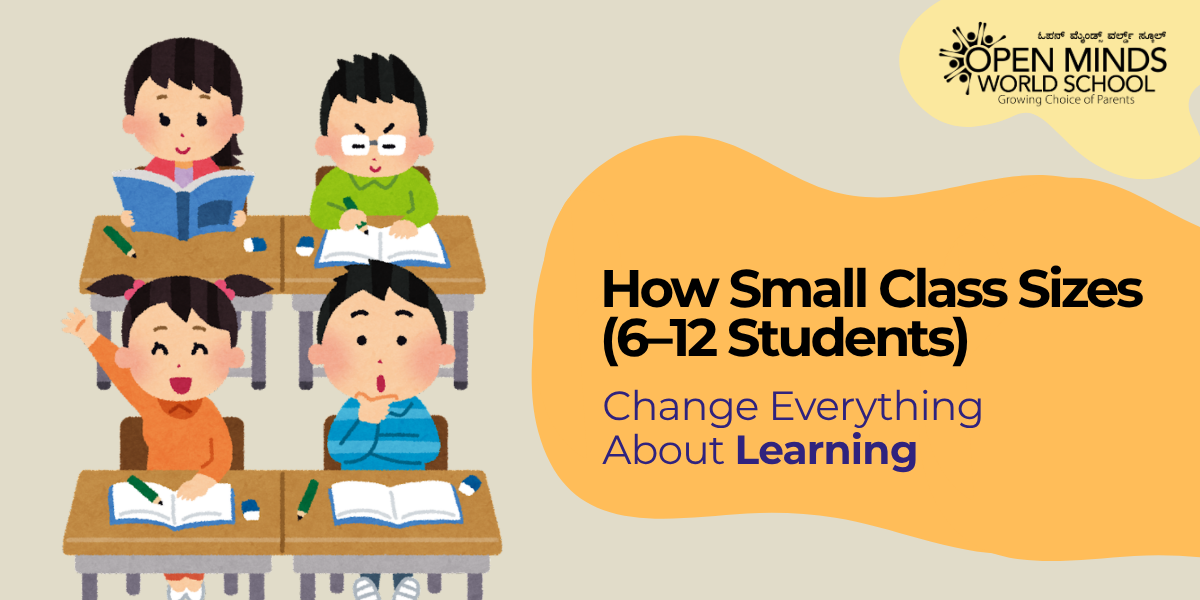
In a group of six to twelve students, the fundamental dynamic of the classroom changes. The educator — or mentor, as we prefer at Open Minds World School — is no longer managing a crowd. They are working with a small community of individuals, each of whom they know well.
They know who came in distracted today, and why that matters for how they approach the morning. They know which students need to talk through a concept before they can write about it, and which need silence. They know whose confidence is fragile and needs careful handling, and whose needs to be stretched. This knowledge is not possible to acquire at scale. It requires proximity and time.
Learning Becomes Genuinely Responsive
In a large class, the curriculum drives the day. In a small group, the curriculum is a resource rather than a master. When a group of eight students becomes deeply engaged in a question that was not on the day's plan, the mentor can follow that engagement — because following it does not leave twenty-two other students unattended.
This responsiveness is not a luxury. It is one of the primary mechanisms through which deep learning happens. The moment a child's curiosity is piqued and then immediately redirected because the schedule moves on is a moment in which learning was interrupted. In small groups, these moments can be honoured.
Students Participate More — and More Honestly
In a large class, most students spend most of their time as observers of learning rather than participants in it. The classroom dynamic rewards those who are confident enough to raise their hand — which is rarely the students who most need to engage.
In a group of six to twelve, there is nowhere to hide — and more importantly, no need to. The smaller group creates psychological safety. Students ask questions they would never raise in front of thirty peers. They express confusion without shame. They challenge ideas and offer disagreements. These are the conditions in which genuine intellectual development happens.
Mentors Can Track Real Progress
In a large class, assessment is necessarily blunt: tests, assignments, and examinations that measure a narrow band of performance on predetermined tasks. In a small group, a mentor can observe the quality of a student's thinking over time — the questions they ask, the connections they make, the way they approach an unfamiliar problem.
This is the foundation of meaningful assessment. It is what makes credit-based evaluation possible. And it is only possible when the mentor knows the student well enough to have genuine insight into their growth.
The Research Behind Small Class Sizes
The Tennessee STAR study — one of the most comprehensive educational research projects ever conducted — followed thousands of children through their school years and found that students in smaller classes significantly outperformed those in larger ones, with effects that persisted long after the students had returned to conventional class sizes.
More recent research has consistently reinforced these findings, with particularly strong effects observed for children from diverse backgrounds and for children in the early years of schooling — the age group that makes up Open Minds World School's foundational stage.
What the research also shows is that the benefits of small class sizes are not primarily about more individual instruction time. They are about a fundamentally different quality of relationship between student and educator — the kind of relationship in which a child feels genuinely known, genuinely safe, and genuinely capable of taking the risks that learning requires.
What the research shows, summarised:
- Smaller classes produce better outcomes — particularly for younger children, and particularly where deep learning is the goal
- Effects persist over time — children from smaller classes outperform peers even after returning to larger settings
- The benefit is relational, not logistical — it is not about more time per student, but about being genuinely known by the adult in the room
- Strongest effects seen in early years — which is precisely why OMWS begins with this commitment at the foundational stage
Why Most Schools Don't Offer This
The honest answer is economics. Maintaining small class sizes is expensive — it requires more educators per student, which directly increases operating costs. It is easier and more profitable to run larger classes.
| # | The Conventional Choice | The OMWS Commitment |
|---|---|---|
| 01 | Larger classes to reduce per-student cost | Groups of 6–12, built into the financial model from the start |
| 02 | Class size as a variable adjusted when budgets are tight | Class size as a non-negotiable, foundational commitment |
| 03 | Assessment through tests that can be administered at scale | Credit-based evaluation that requires knowing each student personally |
| 04 | Curriculum delivered to a group | Curriculum adapted to the individual child within the group |
At Open Minds World School, the decision to cap learning groups at six to twelve students is a foundational commitment — not a feature to be negotiated when costs need to be cut. It is built into the school's financial model, because it is built into the school's educational philosophy. The two cannot be separated.
For families in Shivamogga and the surrounding region who are looking for a school with a genuinely low student-to-mentor ratio, this is one of the most meaningful differentiators to look for — and to verify during a school visit, not just in a brochure.
See What Small Groups Look Like in Practice
Open Minds World School maintains groups of six to twelve students across all learning stages. The difference this makes to a child's daily experience is not subtle — it is structural, visible, and fundamental.
Visit the Shivamogga campus and see it for yourself.
Schedule a Visit →Visit openmindsworld.org to learn how small group sizes shape the daily experience of students and families.